Sonata for Seven |
![]() The Dictionary of Performing Arts in Australia, Vol 2. Atkinson, Knight, McPhee. Allen & Unwin, 1996. Page 213. Sonata for Seven. Ballet. |
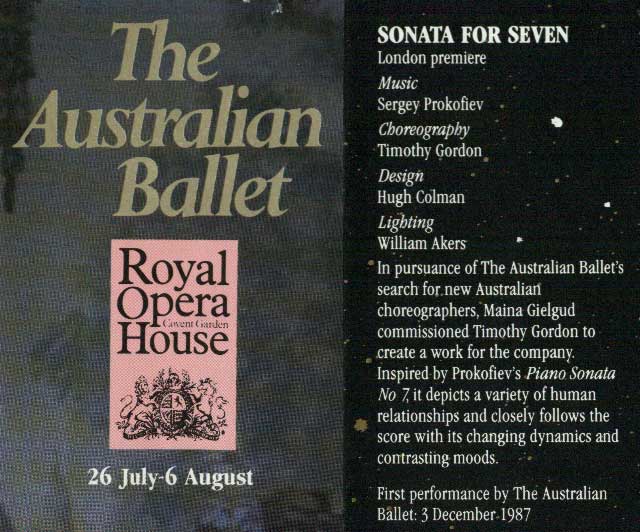
| The New Zealand-born dancer and choreographer Timothy Gordon was commissioned to create Sonata for Seven from a choreographic workshop he held at the Australian Ballet School in 1986. The work was inspired by Prokofiev's Piano Sonata No 7. Gordon worked backwards from the third movement to the first movement, creating a piece that looks at human relationships through a range of moods and dynamics. Performed by the Australian Ballet, the work premiered at the Sydney Opera House in 1987. It also featured as part of the company’s 1988 Brisbane season at the Lyric Theatre, Performing Arts Complex, Brisbane. |
THE TIMES FRIDAY AUGUST 5 1988 Youthful Promise
Australian Ballet |
|
The Australian Ballet were unnecessarily timorous. I think, in scheduling during the London season only one performance of a work by their latest choreographer, Timothy Gordon. His Sonata for Seven shows a bold use of movement and assured stagecraft, and suggests that he has a real gift worth persevering with.
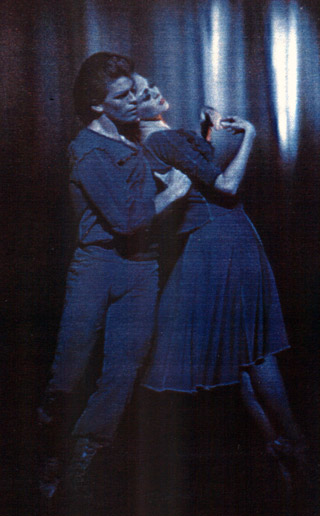
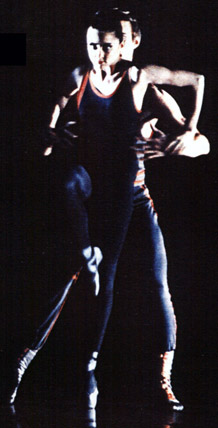
Gordon, a New Zealander, began his dancing career with the Australian Ballet, but his choreographic style shows more the influence of the time he has spent with Netherlands Dance Theatre and the Frankfurt Ballet. The music is Prokofiev’s Piano Sonata No 7. ably played by Nigel Gaynor. Gordon began by staging just the second movement for a studio performance and the ballet’s piecemeal beginnings show in the fact that each section explores a quite different style. First comes an extremely aggressive situation among three men: Brett Morgan is the toughie, Ricardo Ella the victim, and Mark Pace the one who gets by thanks to natural cunning. This section is full of clashes, throws, and falls, all toughly and astutely handled. The second movement shows a woman (Kathleen Reid) whose loneliness is alleviated for a time by a handsome stranger (Steven Heathcote) who may be real or imagined. Finally, there is a quick fiery relationship between Fiona Tomkin and David McAllister. Each of the music’s three movements is reasonably faithfully reflected in the choreography. What the ballet does not do is to draw them together into a coherent whole, although Hugh Colman's costume designs and William Akers’s harsh lighting go a long way to disguise that. J.P. |
|